Minggu, 12 Maret 2006

Just Groovy, Baby!

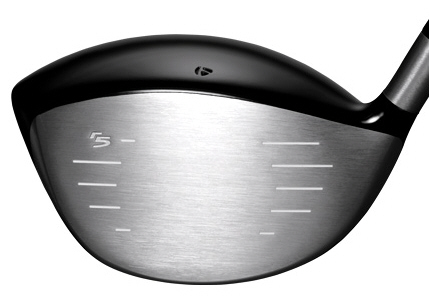
Last summer, I played a round at Angeles National with Rich from Eatgolf.com. We were paired with an older man and his son. Mid-way through the round, the son started to offer Rich some equipment advice. He believed that Rich's drives were too low and he recommended that Rich play with a driver with more grooves to impart more backspin. Upon hearing this, I just grimaced. I had recently read about the topic of grooves on the Internet and I knew that his advice was flawed. As a person who hates to hear bad advice, I felt the need to interrupt. I remarked, "Actually, I've read that grooves on a driver clubface don't add a lick of spin. Just look at the new TaylorMade drivers. They don't even have grooves in the contact area." Everyone just looked at me dumbfounded.

According to equipment guru Frank Thomas, "...the grooves on a driver do nothing with regard to ball spin." In fact, some studies have shown that grooves on a driver can actually decrease spin. Pat Ryan Golf wrote about the findings of Art Chou of Chou Golf Design Labs and Deshou Liang of Drexel University. They discovered that a smooth faced club at low loft angles (less than 20 degrees) produces more backspin than a rough surface.

So grooves on drivers don't add spin. But how about other clubs? Surely, grooves make a difference, right? Yes, just not in the way that most people think.

According to Paul Smith:
The backspin is created by the balls compression on the clubface. This occurs between the time of impact and the moment of separation from the clubface. The clubs swing path and type of head rotation sees the ball mashed into the clubface. The loft presented to the ball distorts it in shape and gives us the launch angle and all of its backspin. The ball does not actually ever ride up the clubface, instead it gets imbedded in the face where the groove lines reside. High-speed photography has proved this. The more loft the greater the backspin.

Therefore, the grooves have zero influence on the launch angle or backspin on the ball. Well known club designer Ralph Maltby built a set of irons with no face groves at all and played with them extensively to prove this point to disbelievers.

Also, in the mid 1980's the USGA undertook extensive groove type testing and concluded that in dry conditions it was loft, not grooves that put backspin on the ball.

So what good are grooves then? Rather like car tyres which work perfectly in the dry, we need them to work in the wet as well. Clubfaces without grooves work fine in dry conditions but with water and grass in the way, the grooves allow some of the trapped materials to be moved from the collision zone. Without groves you may get a high flyer with less spin and in this instance the ball does in fact run up the face - it actually skids up the face on the lubricating water and/or grass.

The Sand Trap offers a similar explanation saying, "The main purpose of grooves is to collect dirt, grass, and water, thus increasing ball/steel contact." So if grooves aren't the primary producers of spin, then how do those pros on TV hit those high-spinning shots? Frank Thomas explains, "pros produce high spinning shots by striking the ball cleanly with a descending blow on an oblique angle..." In other words, perfect ball-striking.

Rabu, 08 Maret 2006

Golf in Northern Ireland - A Royal Flush!


Does your view of Northern Ireland still include images of IRA bombings, British Troops riding around in personnel carriers and a dangerous capital city - Belfast?

Our experience in Northern Ireland has been the opposite of the perceived image. When I tell people that I'm going on a golf trip to Northern Ireland I still get a disapproving look that says "are you mad?" When I tell them that it is a beautiful and scenic place with people that are naturally gregarious and friendly they still don't believe.

There are six top 100 golf courses in Ireland - Ballybunion and Lahinch on the West Coast, Portmarnock and The European Club on the East Coast and Royal County Down and Royal Portrush in Northern Ireland. While some courses come and go from the world top 100, the two in Northern Ireland have remained quietly in their appropriate place on the list since its inception. They are always solidly in the top 25 -- usually in the top 15.

A small minority of courses located in the (former) British Empire have a "Royal" designation in front of their name. This means a member of the Royal family bestowed it upon the club, often times, if they were a member. Both the gems in Northern Ireland have Royal patronage. County Down received its patronage in 1885 and Prince Andrew is the current Royal Patron. Portrush became Royal in 1892 when The Price of Wales bestowed his patronage. The club logos at the beginning of this post, both topped with crowns, are two of the sharpest in golf.


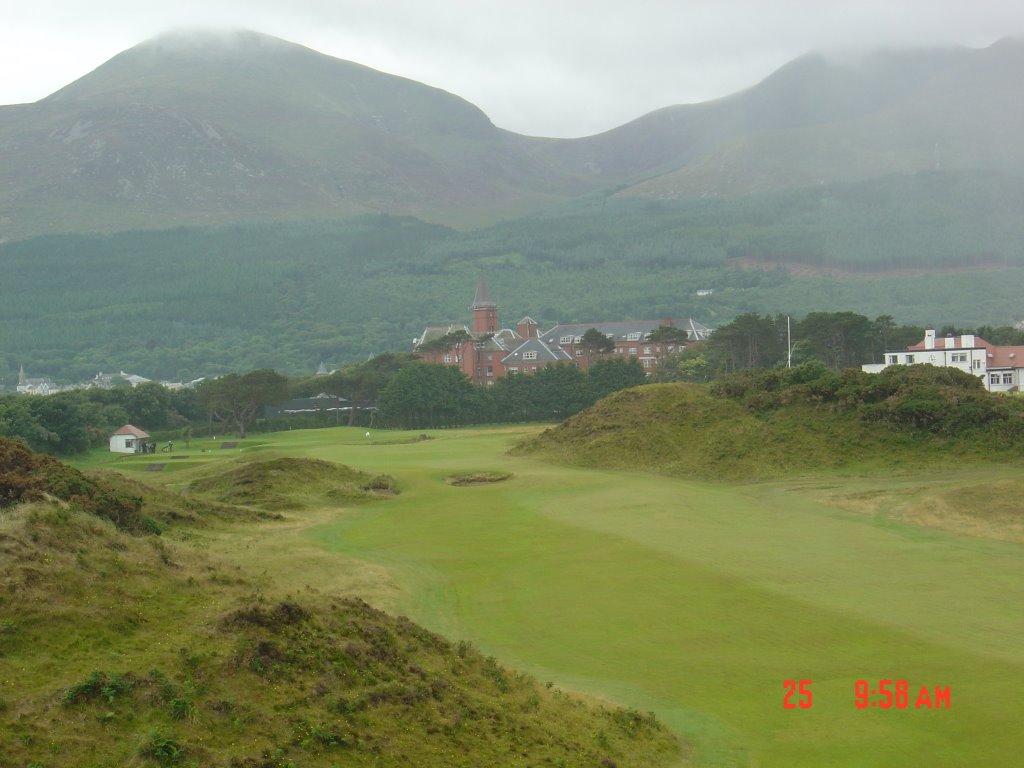
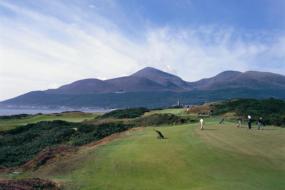
Although located in the same geographic location, the courses have two different personalities. Royal County Down (ranked #10 in the world) is blessed with natural beauty that ranks it among the best in the world for sure. As a backdrop, there are the impressive Mourne mountains which rise up several miles inland and frame the entire area around the course. The course is located on the Irish Sea right next to a lovely beach. Finally, the heather and gorse on the course add to the scenic beauty, but make it quite difficult. If you have the opportunity to play the course when the gorse is in bloom in the Spring, do so. The pictures above and below show the mountains by the sea at County Down.


I have written before that walking up the 9th fairway at Royal County Down is among the most satisfying experiences in golf. Not only do you have a full spectrum of color in all directions, the church steeple rising above the town of Newcastle is on the horizon; the sea is on your left; and the quaint white clubhouse sits in front of you.

The clubhouse at Royal County Down is an understated affair that appropriately befits its Royal patronage. For an American, I always find it quaint to see a picture of the Queen, hanging out of respect. At County Down it is hanging in the bar area that overlooks the course.

Royal County Down was originally designed by Old Tom Morris and was revised by Harry Vardon and still has an old world feel to it. The front nine is the better of the two nines. The back has a weak finish, especially the 17th which is completely out of character with the rest of the course. Imagine how good the rest of the course must be if it ranks this high in the world with 3-4 weak holes. There are many holes on the course where you must hit the ball straight and 200+ yards to carry either a green or a fairway. The 4th hole, a par 3 is one of the most intimidating tee shots you will ever face on a one shot hole. You must hit the ball about 200 yards over a sea of dense gorse. Being short is not an option, since gorse bushes have prickly branches that make retrieving a ball impossible.

There are a couple of blind tee shots where you have to aim over a colored stone placed on a hill. Personally, I like blind shots and for those who think they have no place in golf, I would comment that many courses on the top 100 list have blind shots - including some of the best: Pine Valley, The National Golf Links, Lahinch, Cruden Bay and Muirfield.

If you're not on your game at Royal County Down it will be painful. I have played Royal County Down twice - once in 'fine' conditions as the locals call it and the second time in windy, rainy and cold conditions (in July). Even in miserable conditions it is easy to see that it is a great golf course. I enjoyed both rounds immensely. It is one of the toughest championship links at 7,167 yards from the tips.

Located in County Antrim not far from the Bushmills distillery is The Royal Portrush Golf Club (ranked #12 in the world). The course has been changed several times since its inception, most recently by H.S. Colt. Colt is unquestionably one of the finest architects who ever lived and I personally rank this as his finest effort ahead of Muirfield, Sunningdale and Wentworth (Pine Valley excepted since he only influenced the work of Crump). Along with Carnoustie and Pine Valley it is one of the most imaginative routings in the world. It has a good variety of holes and is challenging.

Portrush hosted the 1951 Open Championship and is worth of hosting one again. Like Royal County Down it does feature a weak finish but again makes up for it on the first 16 holes. The aptly named "Calamity" hole is a demanding par 3 where a sliced ball disappears into a chasm. Look closely at the image below and you can see the green faintly in the distance to the left. The picture is from the tee.


I always advocate taking a caddie for any round of golf if they are available. I especially like caddies in Ireland and Scotland for their wit, humor, wisdom, perspective and charm.

The last time I played Royal Portrush I had a world-class caddie. On one approach shot to the green he told me to hit the ball 150 yards. I was thinking maybe play it an extra 10 yards longer and asked "what if I hit it 160?" His answer I remember to this day - "There's no flag at 160!". This perfectly sums up the best of Irish caddies. They may not be Oxford educated but they have tons of wisdom and dispense it succinctly. If I played with him all the time, I'm sure my handicap would be five points lower.

Each hole at Portrush has a name, and you can only imagine what playing the hole called "Purgatory" is like.There are several holes at Portrush that border on the Irish Sea along the famous Causeway Coastline. The coastline is dramatic and falls away quickly to the sea creating some stunning views. They are nicknamed "The White Rocks" due to their color.

I first visited Northern Ireland in September 1998, not long after the deadly Omagh bombings. Never-the-less, the country did not have a police-state feel to it. There were no border crossing checkpoints or obvious problems. The only noticeable differences to the South are better roads in the North and the police stations look like fortified bunkers with barbed wire. Today, you will still see an occasional IRA or Protestant mural painted on the side of a building. Otherwise, the reality is it's very much like the Irish Republic to the south from a golfers standpoint.

My hope is that both courses remain forever in the top 15 in the world rankings where they belong.

Minggu, 05 Maret 2006

Golf Review: Technasonic Check-Go

Snake-oil salesmen have long found golf to be fertile ground to hawk their wares. I can't think of another sport that has as many gadgets and gizmos that don't do squat. Thankfully, most are obviously junk upon first glance. However, there are some things that make you wonder if it's legit.

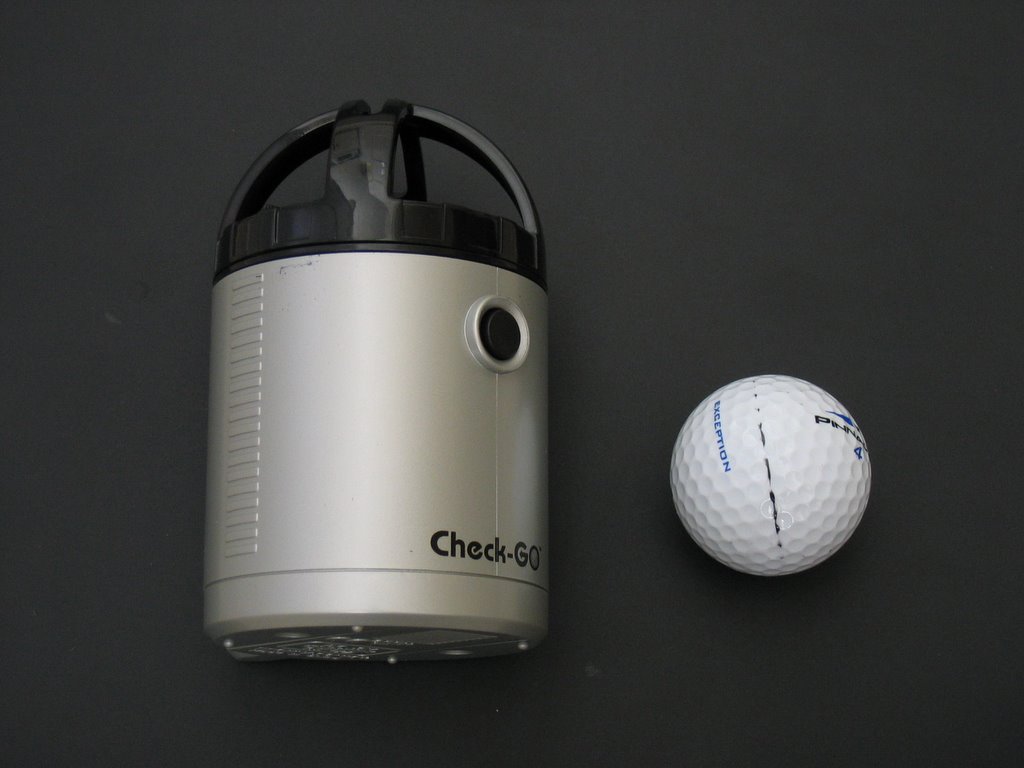
One such gadget that has always piqued my interest is the Technasonic Check-Go. It has been around since the late 80s and it is still a hot seller. In a nutshell, it's a device that's supposed to find the optimal balance point (equator) of a golf ball by spinning the ball at high speeds. Why is this important? Well, if you putt the ball along its balanced equator, it should roll truer on the green. Dave Pelz, the mad scientist of golf, has done research in this area and wrote, "Physics is physics. If balls are not balanced and they are not lined up on their balance point, they’re not going to roll straight."

It sounded good enough for me. I plunked down around 30 hard-earned greenbacks to satisfy my curiosity. Once I opened the package, I inserted my AA Duracells and got "Check-Go-ing" on a new box of Pro V1s. It seemed easy enough; just place the golf ball on the holder, attach the cage, hold down the button to spin the ball, and then mark the ball with a pen. Well, it actually takes some practice.

On my first attempt, the Pro V1 spun wildly out of control when I tried to mark it with the pen. Instead of a straight line along the ball's balanced equator, I ended up with a ball half-covered in ink! But after a couple more attempts, I started to get the hang of it. The key is to let the ball spin up to the maximum speed and then apply the pen to the ball lightly with increasing pressure. To get a heavier line, go back over the Check-Go line with a Sharpie and the method.

For the most part, the Check-Go works as advertised. I have put dozens of balls through this thing and it has always found the ball's balance point. Whenever I re-spun a marked ball, it would return to the same balance point indicated by the original line.

The only gripe that I have with the Check-Go is that the line that is manually drawn is frequently "off" a bit
. The cause of this problem is the way that the pen is aligned and applied to the ball. To draw the line on the ball, the pen is simply inserted into a hole of the cage. Unfortunately, this hole allows some "play" with the pen allowing the pen approach the ball at varying angles. As a result, the line can be off from the true center of the ball. I have a couple of Pro V1s with off-center lines and I find it very distracting when I putt. Technasonic could improve the Check-Go immensely and probably sell a lot more of them if they just devised a way to apply the pen to the ball more accurately.

While I'm confident that the Check-Go does find the balance point of a golf ball, I'm not sure that it really matters in practice. I haven't noticed any difference to my putting results. I'm probably just not good enough to know. But if you believe that balanced golf balls will make a difference to your game, then the Check-Go is a great product for you.

A Message From the Creator

It was with great interest that I read George Peper's article in the March 2006 issue of Links Magazine. Peper was the editor of Golf Magazine when it launched the original top 100 world rankings. Thus, it was Peper as much as anyone who can claim to have created what is now a mania. The article is basically Peper's equivalent of going to confession.

His comments are not to be dismissed since he is a thoughtful observer of the golf world. There does seem to be an obession among developers and designers to get a course into the top 100 rankings. We agree that actively courting raters and trying to influence the outcome is wrong. It remains to be seen how the longevity of many of the new entrants onto the list will survive long term, especially some of them built to have host major championships. Peper says "Egomanicial developers now say, 'build me a top 100 course no matter what it costs." Hmmm. Sounds like a certain New York based developer we know who has bad hair and who finally bought his way into the top 100 with Trump National at #87. Luckily, we are playing the 2003 list so don't have to play it. No doubt it will be off the list in three or four years anyway.

I agree with Peper that it has gotten stupid. So you buy your way onto the list or onto a major championship. The past is littered with courses no one has heard of that hosted one major in the past: Anyone remember Champions Golf Course in Houston, host of the 1969 US Open or Pecan Valley in San Antonio, host of the 1968 PGA?

One of the other problems with having all these new made-for-major courses appear on the list is that you risk pushing off some truly world class courses. It would be a shame if some of the hidden gems on the list such as Cruden Bay, Ganton or Woodhall Spa were someday displaced by all these new designs. The history of the game is important and should be respected. There needs to be a balance between older courses and newer courses and it seems to me that the balance is shifting toward newer, which isn't necessarily a good thing.

For those who have read my write-up of the Fishers Island Club the quote from one of their spokesman is perfect (see our January 2006 archive by clicking here: Fishers Island). At the end of the article, Peper lists the 10 most over-rated courses in the world. This is his list, not mine. Although I agree with him precisely on Muirfield, Baltusrol, The K-Club and Royal Troon. I would have to disagree about Pinehurst and Pine Valley, though.

I also accept his criticism of people who are "conspicuous course collectors". Bless me father, for I have sinned!

Below is the article as published:

Hey, it seemed like a good idea at the time. The magazine got great publicity and sold more ads and copies, and I was proud of our biennial list, the first to rank courses from one to 100. Over time, however, I came to realize I’d created a monster.

“You’ve done our club a tremendous disservice,” Pine Valley president Ernie Ransom told me after we pegged his course as No. 1 in the world. “Everyone wants to play here now, and 99 percent of the requests can’t be granted.” Indeed, clubs like Pine Valley, Cypress Point and Seminole—ultra-private enclaves that had long flown under the radar—suddenly gained rock-star status, with their exclusionary practices bared for the world to see. Some didn’t handle it well.

“We do not wish our course to be ranked, visited or for that matter, known. Please convey that message to your panelists,” said a representative of Fishers Island, the remote and remarkable Seth Raynor course accessible only by ferry from New London, Connecticut.

Others milked their status and bilked their visitors. The best example is surely Pebble Beach. In 1980 you could play there for $50. Now it costs $450, and I can’t help thinking that about $150 of that is attributable to Pebble’s position among the world’s top handful of courses.

Among today’s golf architects, getting a course into the Top 100 (on either GOLF’s “Top 100 Courses in the World” list or Golf Digest’s “America’s 100 Greatest Golf Courses”) is what winning a major is to a tour pro in terms of prestige and marketability. Egomaniacal developers who once said, “Build me a great course,” now say, “Build me a Top 100 course, no matter the cost,” knowing that a sufficiently grand creation will buy a gander from the judges. As an absurd consequence, course designers have become multimillionaires and multimillionaires have become course designers.

Among golfers, we’ve seen the spawning of a new species: the conspicuous course collector, whose life mission is to play as many of the Top 100 as possible. Then there is the subspecies, the conspicuous club joiner, who collects Top 100 memberships as if they were bag tags—which essentially they are.

This wretched excess would be harmless if not for two problems. First, the lists are inherently flawed. No matter how experienced and knowledgeable, a selection panel will not—cannot—get the ratings right, simply because there is no “right.” Rankings are no more than a collective guess, an objective average of subjective opinions.

The magazines do their best to screen raters; GOLF vets candidates by asking them which courses they’ve seen from the current ballot. My recollection is that the minimum standard is 55 percent of the World list and 40 percent of the courses on the ballot. The problem, of course, is that there is no way to verify whether candidates have actually visited all the courses they claim.

The GOLF panel is small and elite—fewer than 100 people—to keep the levels of knowledge and discernment high. The risk is that they don’t see enough courses. The group includes golf course architects—among them Tom Doak (who ran the rankings until his design career presented a conflict), Pete Dye, Jack Nicklaus—under the theory that they are the most perceptive judges. There is a stipulation that they may not vote for their own courses, but I’m not sure that does the whole job.

My suspicion always has been that competitive instinct compels architects to give low grades to each other’s courses, to the benefit of Donald Ross, Alister Mackenzie, et al., who are not competitors for contracts. Nicklaus once asked me why more of his courses weren’t on the list. (At the time, he didn’t realize his votes for his own courses didn’t count.) “It’s partly because we have people like you on the panel,” I replied.

The GOLF panel also includes public relations execs, resort owners, tour operators, photographers, writers and others with close links to courses. The last I knew, all these conflict-of-interest votes counted. I have little knowledge of the Golf Digest panel, except that it includes more than 800 low-handicap golfers, whose identities, unlike GOLF’s panelists, are kept anonymous. With a group that size, some raters inevitably will be more knowledgeable and responsible than others. I’m also not sure whether all low handicappers may be able to judge the capacity of a course to be enjoyed by all levels of player. But the aspect I’ve always questioned is their ultra-anal grading system. Whereas GOLF simply asks panelists to rate each course from A to F, using his or her own definition of greatness, Golf Digest requires a grade from one to 10 in eight different categories. I can assure you that giving even a single mark to several hundred courses requires a fair amount of concentration. I can’t imagine filling in several thousand boxes, at least not with any sustained diligence and accuracy. It’s no wonder the rankings are a source of constant consternation to the magazines.

Over the last two decades Golf Digest has tweaked its methodology more often than Katie Couric has changed her hairdo, and GOLF quietly began a wholesale re-evaluation of its ranking system recently.The second weakness of the rankings is more important. The magic number—100—is simply too small. There are more than 30,000 courses in the world; to celebrate only 100 is ludicrous. Hell, there are 100 great courses within a three-hour drive of Manhattan! As a consequence, countless courses have gone without the recognition they deserve.

I’d like to repair the mess I’ve made, but I don’t really see a solution. I could rank the 100 most underrated courses, but the moment that list was published, those would no longer be the 100 most underrated. All I can do is try to figure out why some deserving courses miss out, and give a kiss to a few of the fairest bridesmaids. I can think of six reasons that great courses are ignored. The first three, as in real estate, involve location.


The 10 Most Overrated Courses in the World

1. Pinehurst Resort & C.C. (No. 2), Pinehurst, N.C. Sorry, those greens are borderline Goofy Golf.

2. Royal Melbourne G.C. (Composite), Melbourne, Australia. The ranked course is a composite of two 18s that no one plays.

3. The Country Club (Composite), Brookline, Mass. Same situation—a composite used only for major tournaments.

4. Muirfield Golf Club, Gullane, Scotland. A fine, straightforward test of championship golf—
and utterly charmless.

5. Baltusrol Golf Club (Lower), Springfield, N.J.
America’s Muirfield.

6. Augusta National Golf Club, Augusta, Ga. If it’s so great, why do they change it every year?

7. Pine Valley Golf Club, Pine Valley, N.J. Superb, but not No. 1—too many holes where you don’t see a tee shot land.

8. Royal Troon Golf Club, Troon, Scotland. Six dull holes—six interesting holes—six dull holes.

9. Seminole Golf Club, Juno Beach, Fla. Elite membership, world-class locker room, typical Florida golf course.

10. The K Club, Straffan, Ireland. Dublin meets Doral.
Kamis, 02 Maret 2006

The Observations of One Who Has Completed The Quest

The following was published by Golf Magazine in 2005:

100-Course Meal

One GOLF MAGAZINE reader made it his mission to play every course on our Top 100 in the World. Then we changed it on him!

By LISA TADDEO Editorial Assistant, GOLF MAGAZINE

At 3 P.M. on April 26, Leon Wentz, a 68-year-old California businessman with a 10 handicap, putted out on the final green at Augusta National for a round of 85. It wasn't his best score on a great course, but it was an achievement nonetheless -- with that round, Wentz had played all of the courses on GOLF MAGAZINE's Top 100 Courses in the World. From backtracking to faraway countries to keeping clear of falling monkeys, Wentz braved a lot to play them all. We asked about the highs and lows of his globe-trotting quest, which began at Pebble Beach in 1996.

Playing the Top 100 Courses in the World is a fantasy for most golfers.

What made you do it for real?
I was flipping through GOLF MAGAZINE, saw the Top 100 World list, and thought, "Now, here's a challenge!" I asked my wife if it would be okay if I made this my chore for the next few years, and she said to go for it. I lost 11 courses because of the list changing. For example, I had to go back to New Zealand three months ago to play one that came up on the last list. I wanted to play the current list, not an old list.


What were some of the adventures along the way?
I traveled 28,000 miles to South Africa for one course. I had to network for three years to get on some private courses in Japan. I've had monkeys fall out of trees onto my tee box, snakes cross my path on the fairway.

What was the best course?
Shinnecock Hills was pure golf. It was the best for me.

The most overrated?
El Saler in Spain, Winged Foot East, Paraparauma Beach in New Zealand.

How about the friendliest?
Ganton, in England. The people were beautiful and I had the greatest time.

Which course would you most want to join?
Shinnecock.

Which course would you never play again?
El Saler. No offense to your panel, but it's just not a world-class course. There are only two holes that justify its existence on the list, and it's not even well-conditioned.

What were your best and worst rounds?
Best was at Quaker Ridge, I shot a 74. Worst was at Pine Valley, I had a 90.

What's the toughest course?
Pine Valley, for sure.

And the most beautiful?
Cypress Point.

What's the hardest course to find without a member guiding you?
Morfontaine in France.

Which one has the best bar?
Jefferson's Bar at Shinnecock.

What was your longest journey to play a course on the list?
28,000 miles round-trip from San Francisco to Durban, South Africa.

What was the worst weather you experienced?
I used five gloves at Lahinch. Four inches of rain fell in four hours.