Senin, 29 Juli 2013

Muscle Back Blades Are Swing-Improvement Irons

Almost a decade ago I wrote this post about how I changed my irons from so-called "game-improvement" cavity back irons to muscle back blade irons. Basically, my golf swing had worsened while playing cavity back irons and became better with muscle back blades. I've concluded that "game-improvement" is clearly a marketing coined term designed to sell clubs to golfers. It's not a stretch for the consumer to assume that such clubs will improve their golf swing. Heck, that's what I thought at first. But in reality, "game-improvement" clubs are designed to simply improve the results of a bad golf swing. That's a big difference.

Now that I've played with blades for virtually the last decade, I believe that they are the best type of irons to improve your golf swing. I recently came across this promo video for the new Mizuno MP-4 forged muscle back irons where PGA Tour Pro Charles Howell III expresses a similar sentiment at the 4:47 mark:


Howell explains:
If my son decides he wants to play golf...I would start him off in a set like this [muscle back blade irons]. You can tell right away when you hit is solid. You can tell right away how to draw the ball [and] fade the ball. This iron right here, if you play golf with this every day, you'll actually get better. It will make you a better player.
So, if cavity back irons are the "game-improvement" irons, then muscle back blades are the "swing-improvement" irons!

Senin, 15 Juli 2013

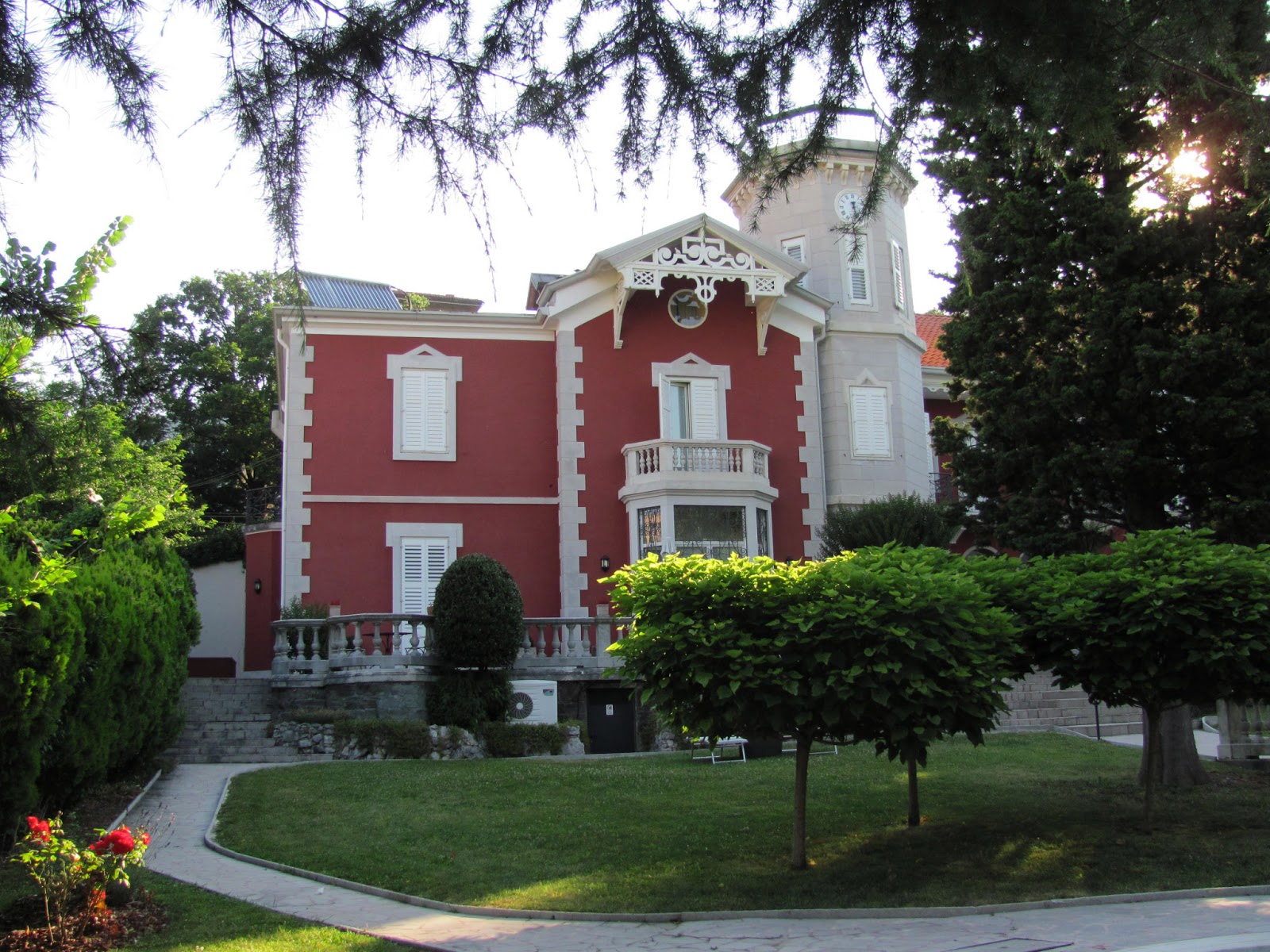
On Location: Villa Bottacin in Trieste, Italy

The Golf Travel Guru living large at Villa Bottacin.
When the double bogeys, snap hooks and three putts get you down and you need a break from golf, I've got a wonderful place for you to stay, recharge, rejuvenate and enjoy "La Dolce Vita" (The Italian Sweet Life).

It's Villa Bottacin in Trieste, Italy,

Recently, Mrs. Guru and I stayed at the Villa and it was one of the more pleasurable hotel experiences I've enjoyed in more than 25 years of spanning the globe in my travel writing career.

Set on a steep hill amid mature trees and lush, colorful gardens, the 17-room villa combines an opulent setting with a slew of modern day amenities such as an outdoor heated swimming pool, complimentary Wifi, satellite television and kitchen facilities in 15 of the units.

While you feel somewhat isolated and buffered by the many trees encircling the villa, you're actually  just a short walk down a steep, narrow cobblestone street to Via Giulia, one of Trieste's busiest main thoroughfares.  At the bottom of the street on Via Giulia is a major mall with a huge grocery store, where you can buy all of the Lemoncello, Frizzante and Prosciutto you'll need to enjoy your stay.

Trieste is a mini San Francisco of sorts with homes and apartments perched on hills surrounding the city center, a cable car and spectacular ocean panoramas. Cruise ships also utilize the deep water port as a stop on the way to Slovenia and Greece.

Villa Bottacin History

Built in 1854 and designed by Swiss architect G. Bernardi, the villa was home to Nicolo Bottacin, a highly respected botanist, who socialized with the Trieste cultural elite. One of his friend's was the Archduke Maximilian of Hapsburg, who lived in Miramare Castle and would often visit the villa.


The magnificent villa was meticulously restored in 2004 and converted into a boutique luxury hotel. A casual perusal of the villa and grounds reveals the renovation team did a marvelous job of enhancing the property with the correct color schemes and attention to detail with a clock on the tower, red tile roof and spacious terrace.

Special attention was also paid to enhancing the garden and property grounds, which contribute greatly to the overall opulent ambiance and exclusivity of the Villa Bottacin.
Villa Bottacin in the morning sun.

Our Room

We stayed in a studio room which was small by American standards but very comfortable with modern conveniences like a kitchenette with a small refrigerator and 2-burner stove and bathroom with a shower and hair dryer.

There are also larger rooms available and only two of the units don't have kitchen facilities.

Our room featured a high ceiling, two large windows with shutters, wood floors, a large closet, small television and a comfortable bed with white sheets. The room charge was a great bargain at $110 a night. Villa Bottacin also offers discounted rates for a week or longer stays.
View from our room with Trieste University in the distance.

Villa Bottacin is located at Vicolo dei Roveri, 16. To contact them, you can phone 39-040-350529, email to info@villabottacin.com or click on their website www.villabottacin.com
The swimming pool is a great refresher after a day on the town or links.

10 Little Things I Like About the Villa Bottacin

1. The wood floors, crisp white sheets and over-the-top cleanliness in our room.

2. The outdoor swimming pool, which we enjoyed every day after we returned from sightseeing, dining and shopping.

3. Large windows with shutters that we opened at night to gaze at the stars above Trieste.

4. No traffic noise even though you're located less than a minute walk from one of Trieste's most traveled streets.

5. A friendly, multi-lingual staff.

6. The large terrace with comfortable, elegant patio furniture where you can relax and enjoy the surroundings and where you can have breakfast during the summer months.

7. The espresso pot provided in our kitchen, which allowed us to enjoy espresso each morning as we planned our day.

8. The excellent Wifi service--absolutely the best I've had in Europe recently.

9. The wonderful view of the Trieste hills and Trieste University from our room.

10. The small table and chairs in our kitchen where we drank Frizzante, and enjoyed Bel Paese, Fontina and Parmesan cheese each night.

Things to See and Do in Trieste

Villa Opicina--A charming village in the hills above Trieste accessible by cable car, bus or taxi. It's a great place to escape the hustle and bustle of Trieste. A couple of exceptional places to dine are Bar Trattoria Max (try the veal Milanese and calamari on Friday fish day) and Trattoria Costilina Veto (best pizza in Europe, in my opinion).

Muggia--A small coastal village accessible by boat (a 30-minute ride) that has a nice group of restaurants specializing in seafood. If you like calamari and fried sardines prepared to perfection, try Osteria Al Corridoio.

Castle Miramare--Stunning white castle built from 1856 to 1860 that sits on a promontory overlooking the sea. It was constructed for Austrian Archduke Ferdinand Maximillian and his wife, Charlotte.

Barcola Beach--A rocky beach with a long, wide sidewalk for strolling that's just a few miles from the city center and easily accessible by bus or boat.

Castle San Giusto--Set on a hill above the city center, this fortress built between 1470 and 1630 has a museum, open-air theater and offers spectacular views of the city, harbor and hills in the distance.

Viale XX Settembre--A popular, walkable and shady promenade lined with outdoor cafes, fast order restaurants and gelato stores.

Piazza Unita d'Italia--A spacious square overlooking the ocean that serves as the main gathering area for Triestinos.

Shopping on Corso Italia--Main shopping area for clothing and gifts where major department stores, Coin and Upim, are located.

Forst Birreria--A restaurant near the Trieste to Opicina cable car stop that features fresh draft beer and huge platters of wienerschnitzel and bratwurst.

If You Want to Play Golf

For those who want to tee up in Trieste, most tourists gravitate to the Golf Club Trieste, an 18-hole layout with club rental, driving range and putting green located about a 25 minute drive from the city center. Greens fees are in the 55 to 65 Euros range. For more information, call 39-040-226159, click www.golfclubtrieste.net or email info@golfclubtrieste.net

To Get There

The most convenient way to visit Trieste (at least for Americans) is by flying into Venice's Marco Polo International Airport, which is a one and one-half hour train ride or car drive from the city center. Trieste is situated in the far northeastern corner of Italy near the Slovenian border.



Minggu, 23 Juni 2013

Match Play Upsets Ruin The NCAA Championship

Match play is an exciting golf scoring format. It turns golf into a mono y mono contest where the winner is determined solely by the number of holes won. There's no bonus for the margin of victory on each hole, just one point is awarded for each hole won. As a result, it is "the great equalizer" and has proven to produce far more upsets than the standard stroke play format. In basketball, the NCAA Basketball Championship is known as "March Madness" due to the crazy number of unexpected upsets. But it can't hold a candle to match play golf. The Wall Street Journal compared the winning percentages of higher seeds in golf's WGC-Accenture Match Play Championship to March Madness. They found that the higher seed in basketball won 72% of the time compared to only 60% in golf.

So it's fairly obvious that the match play format sacrifices a bit of fairness for excitement and suspense. It's rare that the player hoisting a match play trophy is truly the best golfer in the field. Perhaps that's the reason there's only one match play tournament on the PGA Tour. But it also makes you wonder why the NCAA added match play to the Men's Golf Championship in 2009. Isn't this the final tournament of the year with the sole purpose of identifying the best team in college golf?

The tournament's current format is 54 holes of stroke-play followed by a match play playoff among the top 8 teams. As one might predict, the format is producing unpredictable results. Of the five tournaments so far, four of the #1 ranked golf teams have been upset. But this year's 2013 NCAA Championship featured the biggest upset of them all. Cal was the best college golf team this year and perhaps all-time. Just check out these fun facts:

  • After winning its first two events, the team was ranked #1 and held that spot all season.
  • The team set a modern-era NCAA record with 12 victories in 14 stroke-play events.
  • Every starter won at least one individual title this season.
  • Each starter finished the season with stroke-play averages under 71.00
  • The starters finished the season ranked individually #1, 11, 12, 13, and 19 by Golfweek.
  • Three starters were first-team Ping All-Americans, the other two are on the second-team.
  • The head coach, Steve Desimone, was named national coach of the year for the last two years.

So it was no surprise that Cal crushed the competition in the 54-hole stroke-play portion of the 2013 NCAA Championship by six shots. Entering the match-play portion seeded #1, it was also no surprise that they would be upset by lowly Illinois, the #20 ranked team in the nation.

If this doesn't cast a bright spot light on the deficiencies of the match-play format, nothing will. It's simply not fair for a team that has proven all season it is the best by a wide margin to have it all come undone over several hours of random heads-up golf. Under a conventional 72-hole stroke-play format, Cal would have rightfully run away with the title. Every competitive golfer knows that stroke-play is the best overall test of golf. Heck, it worked for the NCAA Championship for the 44-years prior to 2009. It's clear that the NCAA's effort to spice things up with match-play has been a failure and diminishes the legitimacy of the title. After Illinois upset Cal, Desimone said, “All today does is demonstrate again that this is not the best way to crown the national champion.” It's just a shame that arguably the best college golf team of all-time will fade into obscurity due to a poorly conceived championship format. In this regard, match-play is truly upsetting.

Selasa, 18 Juni 2013

10 Great Golf Travel Packing Tips

 
Turnberry Resort in Scotland
You're finally embarking on your golf dream trip and you know you'll need to take your “A” game, right?

Be aware, golf travelers, if you don’t pack carefully you might end up with so many annoyances and hassles that playing your best is almost impossible.

Here are 10 invaluable tips I can share that’ll help your trip be full of great memories. Some of these I learned the hard way by forgetting them or foolishly disregarding advice from fellow golf travelers and writers.

1. Invest in a top quality travel cover—Absolutely, positively don’t try to save money by purchasing a cheap travel cover. You can protect your golf club investment by getting a cover from a respected company like Club Glove, Ogio or Sun Mountain.

More Tips:
·      Don’t select an all-black cover so you can avoid looking like everybody else. You’ll save time finding your bag on the carousel if it has a recognizable color treatment.
·      Use your travel cover as an additional piece of luggage by packing shoes and extra shirts on departure and dirty laundry on your return.
·      Make sure your nametag or business card is placed on the outside of the bag and the inside as well, just in case the outside card is displaced.


2. A lightweight carry Bag for the British Isles—If you’ve every played golf in this part of the world, you’ll notice that the most experienced caddies gravitate to the lightest bag in the group. Show up with one of those huge staff bags and you’ll be treated like someone with a contagious disease.

3. Microfiber clothing—These amazing fabrics were made for golf travelers. They’re lightweight, wrinkle resistant and dry quickly.

4. Quality golf outerwear —If you want to be miserable, I mean truly miserable, take a golf vacation to Scotland, Ireland or the Monterrey Peninsula in California with some ragtag, makeshift rainwear. Standing in a fairway with a thirty-mile an hour cross wind and a heavy downpour without adequate protection is not a memory you’ll treasure. Top companies, include Sun Mountain, Sunice and Zero Restriction.

5. Take some stain remover for mud--If you don’t, you might bring home a mud-splotched pair of golf slacks or khakis as a souvenir of your trip.

6. Waterproof golf shoes (with shoe trees)—You must have a dry pair available in case you get caught in a downpour. Ideally, you need to take at least two pair of waterproof golf shoes, especially on trips four days or longer.

7. Quality golf umbrella—Don’t depend on the cheap logo umbrella you received as a gift at your last corporate golf tourney. Invest in a top quality umbrella that can withstand strong winds and, more importantly, keep you dry between shots.

8. Sizeable golf ball inventory—In my experience, buying golf balls outside of the U.S. always involves serious sticker shock and a suddenly exploding travel budget.  Obviously, if you’re a high handicapper you’ll need more golf balls.  Honestly evaluate your game to calculate how many golf balls will be enough.

9. Extra items—If you’re traveling in the British Isles or just about anywhere away from the continental U.S., make sure you take extra tees, pencils and divot repair tools which aren’t as readily available at golf courses outside the U.S.

10. Healthy snacks—You’ll be glad you packed a couple of boxes of granola bars and packages of peanut butter crackers, especially if you’re playing in the British Isles. While the beef barley soup and fish and chips are treasured favorites after a around, you’ll need some healthy fortification during play.


Minggu, 09 Juni 2013

10 Things You Should Know About U.S. Open 2013 Merion Golf Club

The U.S. Open is going "Old School" in 2013 with Merion Golf Club (East Course), a classic layout in Ardmore, Pennsylvania opened in 1912.  This is not your typical 7,700-yard behemoth course where you "grip it and rip", then grab a wedge on par fours and go eagle and birdie hunting on par fives.

Playing from 6,996 yards (36-34-70), Merion is the first U.S. Open course under 7,000 yards since 2004.

The Merion East Course will quickly identify the contenders and expose the pretenders. Accuracy off the tee, shotmaking, and exceptional putting are necessary ingredients to score well on this layout with its deep rough, slippery smallish greens and difficult bunkers.

Here are 10 things you might not know about Merion:

1. Wicker Baskets-You won't see any flags on pins blowing in the wind. All of the pins are topped with a small wicker basket.

2. Only Two Par Fives-Yes, that's right. There are only a couple of par fives (556 yard no. 2 and 628 yard no. 4) on the entire course. In fact, the back nine has no par fives.

3. Long Time, No See--Merion has been out of the rotation for a while and has not hosted a U.S. Open since 1981.

4. The Golf Course Architect--The course was designed by Hugh Wilson, a Scottish immigrant member who had never designed a course.

5. Give Me a Yardage--There are no yardage markers anywhere on the Merion East Course.

6. Walking Only--The Merion East Course is walking only with an exceptional caddie program.

7. No Breakfast Balls--One of the strongly enforced rules for members is "No mulligans on the first tee."

8. Menacing Bunkers--The Scottish style bunkers on Merion East are known as "the white faces of Merion."

9. Hogan Legend--Merion is the site of Ben Hogan's famous 1-iron Shot in the 1950 U.S. Open.

10. Bobby Jones History--In 1930, Bobby Jones achieved the "Grand Slam" at Merion with his U.S. Amateur Victory.