Kamis, 17 Juli 2008

Bandon Dunes Vacation Trip Tips: Part II, Be Prepared!

Bandon Dunes is fast becoming the North American golf mecca. Recently, I had an opportunity to take a Bandon Dunes golf vacation with some good golf buddies. I have already written about my . Here are my thoughts and tips on how to prepare for the golf at Bandon Dunes:

True British Open-style links courses in the U.S.!

Bandon Dunes is three-course golf resort situated on an isolated part of the rugged southern Oregon coastline. Re-creation of the traditional links courses of Scotland and Ireland is the name of the game here. In my 10+ years of playing golf, I have never played a true links course. So what I found at Bandon was golf unlike anything that I've ever played in my life. Natural contours from seaside dunes meant that there was rarely a flat lie. Fairways were very firm with tightly mown grass. Carts and cart paths were non-existent. On the course, about the only man-made structures that will come into view is the Lodge/clubhouse. The courses are isolated from civilization and you definitely feel it!

Rain and Wind are Par for the Course

One of the things that I hate is playing golf in the rain and/or cold. As a spoiled southern California golfer, I've become accustomed to dry and warm weather. Usually, if there's any chance of rain or the mercury dropping below 60, I don't even bother driving to the golf course. There are just too many sunny days here to have to play in those conditions! But I knew that rain, wind and cold are all considered the norm at Bandon Dunes. In fact, such playing conditions were the only apprehension that I felt when I booked my trip. Eventually I figured what the hell, this is a once-in-a-lifetime golf trip! I just have to man up and be strong mentally. But the biggest dilemma was how to prepare for the rain...

Get Wind and Waterproof!

Before my Bandon trip, I owned no rain equipment. Unfortunately, high quality golf rain gear is expensive. A good rain suit is well over $300! Would it be worth spending so much money on equipment that I may just use on one trip? I concluded it wasn't. Instead of a heavy-duty rain suit, I opted for a light-packable rain suit for around $50. Sure enough, during our first round it rained and it rained hard. While my rain suit kept me dry, it didn't fit well at all. It was bulky and adversely affected my swing. I was definitely second-guessing my penny-pinching decision. It rained again during our next round, but luckily not again for the rest of the trip! It turned out that being a cheap-skate didn't bite me back too badly. But if it rained any more than it did, I would think that a high-quality rain suit would have been worth it. Not only is it important that a rain suit keep you dry, but it should allow you to swing as freely as possible. Other essential golf rain gear that you must pack:
  • Shoes: Nothing is worse than water getting into your shoes. I really never quite understood that concept until it happened to me on my Bandon trip! My socks got wet and my feet started to swim in my shoes. That caused blisters to form!

    I just assumed that my shoes were waterproof because it came with a 2-year waterproof warranty. Unfortunately, I have been using them well past the warranty period and they must have lost their waterproofing ability. Don't make my mistake! Be sure to use waterproof golf shoes and make sure that they are still within the warranty period. It's also a good idea to bring another pair of shoes to rotate amongst and allow proper drying between rounds. Remember to stuff 'em with newspaper after the round to dry them properly!

  • Headwear: The wind chill at Bandon can be brutal. In such conditions, you lose much of your heat (30% or more) through your head and neck! That's why it is so important to preserve warmth by donning a winter hat. Choose hats made of wool, polyester or acrylic knits that stay warm when wet. Also, look for non-itch materials or linings for comfort. I choose a high-quality beanie hat made for mountain climbing. It was made of Polartec for warmth and had a Windstopper lining to prevent wind and water penetration. It was a little more expensive, but well worth it!

  • Gloves: Golf rain gloves allow you to grip wet grips. Unfortunately, they don't keep your hands warm in the cold!
Adjust Your Game

Links courses and their associated weather conditions require certain adjustments to play them well. The biggest adjustment for me was hitting off of the firm and unyielding sand-based fairways. I'm used to fairways with supportive turf that sits the ball up off of the ground beneath. However, the grass and ground seem to be one and the same on a links fairway. As a result, it is unforgiving to less than perfect ball-striking. Even simple chipping and pitching is maddeningly more difficult on a links fairway. Hit the ball just a fraction fat and you'll flub it. I must have averaged 4 chunky chili dips per round with my wedges until I just gave up and putted them instead! There's a good chance that putting is your best option for anything on the fairway within 30 yards of the green. Watch this week's British Open to see how it's done. If you are lucky enough to play Bandon, be sure to check out their practice facility to get used to that pesky turf.

Stay tuned for Bandon Dunes Vacation Trip Tips: Part III, On the Course!

Senin, 14 Juli 2008

Summer Holiday


I will be taking a short break from posting to enjoy the remainder of the summer. I will resume posting around the Ryder Cup with an exciting lineup of courses.

As my regular readers know, I have been trying to arrange a trip to play in Japan, home of three top 100 courses. On the good news front, I have a trip arranged for the Fall and will be providing a blow-by-blow account of my Asian trip while there, with plenty of pictures.

As I mentioned in my writeup of Friar's Head last year, the party looked like it was about to stop. The excess display of wealth that their grandiose clubhouse represented signaled to me that there was trouble ahead. Trees don't grow to the sky and excessively extravagent golf courses can't be built forever. Not only is Loch Lomond being put into receivership, but tales of woe abound in the high-end golf circuit about Wall Streeters having to put their $3 million Hamptons home on the market at fire sale prices and having to ditch the kids private tennis coach. A recent apres-round Southside at Maidstone confirmed a sense of schadenfreude among the Social Register crowd. I can attest that they are feeling no pain at this WASP bastion and a pullback among the masses puts them squarely back at the top of the heap. Their grand-parents made money the old-fashioned way, unlike these upstarts, so it can be satisfying to see the arrogant new money types get their comeuppance.

The mortgage meltdown and bear market are inflicting pain on many of us, your faithful blogger included. The small indignities I have had to suffer include doing my own laundry to save on dry cleaning and taking the subway instead of a black sedan. Worst of all, I will be doing the fourteen and a half hour direct flight to Tokyo in coach. I can hear the sympathy cries going out now. Thank you for your support. These are in fact, tough times.

I must say that I hope our own Gilded Age is not at and end. I am pulling for the new-money types to make a comeback. They have been a good source for me to gain access to some of these high-end private clubs.

Below are two pictures from the Charles Blair Macdonald gem in Bermuda, The Mid Ocean Club, taken during more prosperous times. Have a safe and enjoyable summer!


The 3rd hole at Mid Ocean

View from the 18th tee at Mid Ocean

* My two proof readers (in their 20s, like many of my tech saavy readers) didn't recognize Gregory Peck and Audrey Hepburn from the 1953 classic Roman Holiday. Their loss.

Senin, 30 Juni 2008

Merion - Drama, Comedy and Tragedy

It's not often that I re-post a course write-up. I got a chance to play Merion again earlier this year with my digital camera in tow and have posted some great new pictures with this new posting.

Shockingly, many of my readers inform me that they like my pictures more than my prose. Humbug.


Most major cities have their well-healed suburbs - in New York Greenwich and Darien. In Chicago, the communities along the North Shore of Lake Michigan. In Philadelphia, the affluent leafy suburbs are known as The Main Line. Named after the train line west of the city, the Main Line is old-world, understated, affluent and traditional. Merion is located in the heart of Philadelphia's Main Line and plays the part well. The land that the course and clubhouse are on trace their title back to William Penn.

Memory is not one of my strengths. One minute after meeting someone, I don't remember their name. Many times I have had to look at the bag tag of the member I'm playing with every three holes to remember his name and not make a complete fool of myself. And, I have gotten very good at not saying names. "Nice shot" instead of "Nice Shot, Dave", in case his name is in fact Bob.

There is, however, a part of my memory that works very well when it sees something memorable. I have found that the mark of a truly great course is how well you remember it both immediately after a round and six months later. Using this measure, Merion is a truly great course. After playing it once I could describe every hole in detail. The shape, terrain, bunkers, doglegs, green contours, etc. At Pebble Beach you sort of feel compelled to like the course because it is so pretty and everybody raves about. But, if you're being honest with yourself, aside from the eighteenth hole, can you visually remember all of the holes at Pebble? I'll bet you can't. Merion is seared into my memory. So far this has happened to me on only three courses in the world: Merion, The National Golf Links of America and Cruden Bay.


The 18th green as seen from the second floor locker room

What makes Merion so memorable? It is the ultimate strategic golf course. It is not a terribly long course. At Merion, you have to hit the fairways or it will be a long day. Second, you have to be on the correct side of every fairway in order to have a decent shot at the green. And finally, you have to be on the correct part of the green or you're in three putt territory. On every green. Also, the shot variety is really good as are the changes in direction, doglegs and uphill/downhill shots. No monotony here. As if the golf course itself is not good enough (and it is) you also have the grandeur and majesty of the white pillared clubhouse and the Bobby Jones and Ben Hogan history.
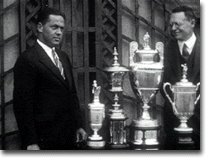
Bobby Jones with his grand slam trophies at Merion

If there was ever a course that new equipment risks destroying, it is Merion. It is too bad that the U.S.G.A and R. & A. have let the situation get out of hand and length is now the primary driver of competitive golf. It would be a shame if this course is lost from major competition forever.

I consider Merion to be the spiritual home of golf in the U.S. due to its greatness, its history, its association with Bobby Jones and the architecture of the course and the clubhouse. Merion's east course was designed in 1912 by Hugh Wilson, a Princeton graduate and captain of their golf team. The club traces its roots back to 1896 as you will see on the club's logo and evolved from the Merion Cricket Club.

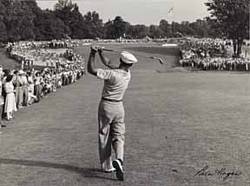
This is the first course Bobby played a major on (the 1916 Amateur), the first course he won a major on (the 1924 Amateur) and the last course he played competitive golf on (the 1930 Amateur), completing the fourth leg of the Grand Slam at Merion in September 1930. Also, the classic photograph which is the golfing equivalent of the ironic shot of the sailor on V.J. Day kissing a woman in Times Square, was taken at Merion.
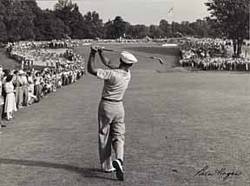


Ben Hogan on Merion's 18th hole at the 1950 U.S. Open

Taken by Life Magazine photographer, Hy Peskin, it shows Ben Hogan hitting a one iron on the eighteenth hole in the 1950 U.S. Open. It is an iconic picture of this great player at one of the most historic of courses in a perfect finish position. Hogan almost stopped playing during this final round because he was in such a state of fatigue recovering from a near fatal car accident the year before. Hogan hit the one iron onto the green and made a par to qualify for a three man playoff the next day which he would go on to win. It is one of the most heroic finishes of all time.


The short par three 13th hole as seen from the tee, shows off the Merion bunkers

Merion has many unique characteristics: the red wicker baskets as flags, the bunkers with clumps of grass in the middle (known as the white faces of Merion) and the scene around the first tee. You tee off right next to the outside patio with its green-and-white striped awning, with members and guests about five feet away from the tee box. It is one of the best opening holes in golf. The view in all directions is impressive; the clubhouse building with its white-washed stone and porch, the green awnings, the mature trees, the wicker baskets.  The wicker baskets are red on the front nine and orange on the back nine.

Merion also still has what has unfortunately become a rare entity in American golf: Experienced caddies, and lots of them. The clubhouse, which is listed on the National Register of Historic Places is the golfing equivalent of St. Peter's. Also, like the Vatican, Merion upholds the traditional and the conservative in the game and in many ways is truer to the traditions than golf's governing bodies because they don't have to compromise with the equipment manufacturers. In addition to no pin flags, there are no yardage markers, no range finders allowed and no golf carts.

In the clubhouse and on the course at Merion you naturally speak in hushed tones and in a respectful manner. It sounds absurd but it is close to a religious experience.


Looking back from the first tee at Merion


Merion is also what I call a deceptively long short course. How about two par threes that can play more than 250 yards each? The third and seventeenth are long par threes with exceedingly difficult greens. Yes, the course has some short par threes and some short par fours but there are also some quite long holes mixed in. Part of the genius of architect Hugh Wilson was the mis-direction he used from the teeing grounds. The first hole is a good example as the tee point toward the left rough. The eleventh tee is pointed toward the right rough and the finishing hole directs the golfer toward the trees to the left of the fairway. Very subtle, but important. Most of Merion's greens are also set at an offset angle from the fairway, making the distance tough to judge and ensuring that missing the green is always in play.


The first tee as seen from the 18th green


No question it is one of the best opening holes in golf, along with Prestwick and The Old Course at St. Andrews. The tee box is located right next to the dark green awning next to the big tree. Since you are standing five feet from the membership having breakfast or lunch, it is a high pressure tee shot. How do you keep a short course relevant? Merion is a classic example of how. The fifth hole is a good example, a long par four with a stream all the way down the left side. This hole was designed along a side hill so the entire hole, fairway and especially the green slope from right to left. All but two perfectly struck balls will end up far left of your intended target.


The par five 4th green plays over a little brook and like many at Merion slopes back to front

The fourth hole (above) is a downhill par five that requires a precision shot, normally from a downhill lie, to a well bunkered green over a creek. Merion also features a half-dozen or so blind shots including this tee shot. The world-class eleventh also features a tee shot where you don't see your ball land either, as does the challenging sixteenth hole which begins the plan through the quarry.


The green on the short but tricky par four 7th hole


The green on the 11th hole, one of golf's most historic. Jones finished the grand slam on this green

When you play the eleventh hole, where Jones finished his match in the 1930 Amateur to win the Grand Slam, you have chills up and down your spine. I have, on the half dozen times I've been fortunate enough to play. Like most holes at Merion, there is just no margin for error on approach shots to the green. Dan Jenkins describes the shot into the eleventh green with absolute clarity as, "There is hardly any shot that will do except the perfect one." The hole is under 380 yards in length, so likely you will only be hitting a wedge, however, the combination of the small green, the water on three sides and the historic setting make it a nerve-wracking shot.


13th green - short par 3 near the clubhouse


16th "Quarry" hole approach to green. Better check your knickers.


The sixteenth, seventeenth and eighteenth play through an old quarry and are demanding finishing holes. After hitting a tee shot on sixteen to a snaking fairway that is not visible you face one of the most difficult shots on the course. There is a forced carry over the teeth of the old quarry to a diabolical green. The green is multi-tiered and slopes back to front. Being long when the pin is below you will mean an almost certain three putt. Seventeen is a long downhill, challenging par three. If there was such a thing as a par 3.5, this hole would be it. A par feels like a birdie. The drive on eighteen is back over the quarry. If you are lucky you will hit to where the famous plaque is where Hogan hit his famous one iron shot. Merion unquestionably has one of the best finishes of golf anywhere.


The sun setting on the 18th green

Golf Digest editor Jerry Tarde described Merion as a three-act play: The Drama of the first six demanding holes; the Comedy of the next seven short, precision holes; and the Tragedy of the last five punishing holes. As the players in the 2013 U.S. Open found out, Merion still has teeth even as a 'short' course. The combination of canted fairways, subtle breaking and very fast greens, forced layups on many holes and an unheralded number of long holes mixed in continue to make it relevant. it was no surprise to me that the par four fifth hole which slopes from right-to-left the entire way, played so difficult. Only one player played it under par over four rounds. Also, no surprise that the finishing hole proved difficult. No player birdied it on Saturday or Sunday.

Merion is one of my personal top five places to play golf. If you get invited to play Merion, by all means make the pilgrimage.

Sabtu, 21 Juni 2008

Tigers are Tough, Especially the Human Kind

A couple of years ago, ESPN's Gene Wojciechowski wrote an article that included a seemingly absurd proclamation that "Tiger Woods is the greatest individual athlete of our time. OK, of all time." After Tiger's unhuman-like performance at the 2008 U.S. Open at Torrey Pines, Wojciechowski's statement might be right on the money. Winning the most difficult tournament against the world's best with a torn ACL and a double stress fracture is nothing short of miraculous. Unfortunately, recovering from that injury will cost Woods the rest of the season. It seems that Wojciechowski might be the Carnac the Magnificent of golf with his prescient statement: "Only injury stands between Woods and any record worth owning."

But there are always haters out there who will try to bring you down. Surprisingly, the sharpest barb came from the usually docile Retief Goosen, himself a two-time US Open champion. When asked whether he believed that Woods was faking the extent of his pain, he said: “I think so. It just seemed that when he hit a bad shot his knee was in pain and on his good shots he wasn’t in pain. You see when he made the putts and he went down on his knees and was shouting, ‘Yeah’, his knee wasn’t sore. Nobody really knows if he was just showing off or if he was really injured. I believe if he was really injured, he would not have played.” Retief later tried to downplay his jealous-tinged remarks saying, “I was being light-hearted. No one but Tiger himself knows how badly hurt he was. But if he was really badly hurt, he would have withdrawn, wouldn’t he?”

Well Retief, maybe your wuss ass would have withdrawn, but Tiger is tough as nails. In addition, you just gave Tiger the extra motivation to crush you every time you set foot on the same course that he does. Get better soon Tiger, and when you get back it will be open season for Goose hunting. He may or may not be the greatest athlete, but Tiger Woods is the greatest competitor!

Minggu, 15 Juni 2008

Oakland Hills Country Club


The Oakland Hills Country Club, South Course (ranked #25 in the world), was originally designed by Donald Ross in 1918. Walter Hagen was the first head pro at Oakland Hills. The South Course has played host to the U.S. Open six times: 1924, 1937, 1951, 1961, 1985 and 1996. It also hosted the 2004 Ryder Cup and the PGA Championship in 1972, 1979 and again this year.

Oakland Hills represents my 75th course played out of the top 100, only 25 to go!


The Oakland Hills Clubhouse, which was modeled after Mount Vernon


Oakland Hills is located in the affluent Detroit suburb of Bloomfield Hills. The club has two courses - the South Course which hosts the championships and also a North Course across West Maple Road. Oakland Hills is similar to several other championship venues that play host to major championships: two courses, a big clubhouse and a lot of property for tents, concession stands, etc. I found it similar in this regard to Oak Hill, Winged Foot, Medinah and Baltusrol. The memorabilia in the clubhouse attest to its esteemed place in the golf world, especially the walk down the long white corridor between the grill room and the pro shop, lined with pictures and signed competitor displays.


Near the first tee of the South Course are plaques of all the players who have won championships at Oakland Hills. The most famous, of course, was Ben Hogan's victory in the 1951 U.S. Open when he famously said, "I am glad I brought this course, this monster, to its knees." He also said that it was "the greatest test of golf I have ever played and the toughest course." Oakland Hills was an early example of a real estate development linked to the building of golf course. When originally conceived in the early nineteen-teens lots were laid out for sale encircling the golf course.

Robert Trent Jones made significant changes to the course prior to the '51 Open and is credited with making the course a lot more strenuous. The sixth hole, seen below, is representative of what makes it a difficult course: its well placed bunkering, along with its length and tough greens. This hole also has a two-tiered green. As you would expect at a championship course of this calibre, the greens are very fast and have many challenging pin placements.


The 6th hole

I wasn't wowed by the front nine. It is a demanding set of holes of championship quality, but nothing that jumps out at you. The best hole on the front is the difficult par four fifth hole, the #1 handicap. It plays 490 yards from the championship tees to an elevated, elongated green with bunkers very close to the green surface. In my view, the course really begins on the tenth tee.

The tenth hole as seen from the tee


According to the club history, when Ross started routing the course, he started it with #10 and #11, two world-class holes. The tenth hole is a 462 yard par four where the entire fairway falls off to the right. The tee shot requires precision and all but the perfect shot will feed down the hill to the right side of the fairway, leaving a blind or semi-blind shot to the elevated green. What makes it such a tricky tee shot is that visually off the tee you have to hit it at the tree you see on the left side of the fairway. The tee box and visuals trick you into hitting it to the right side. It is very well done.

The 11th hole from the tee


The 11th hole plays parallel to the 10th in the opposite direction. The trick on the 11th hole is to favor the left side off the tee. On this hole the fairway also slopes severely left to right off the tee, where a shot that is not struck well will leave you a blind shot to a difficult green.

The 11th hole with its twisting hills


If you hit it to the correct spot over the hill, the fairway then slopes severely right to left. The effective landing area you hit into is quite narrow. In our group, all four of the golfers hit into the rough on the left. You need to take the perfect angle to hit the shot correctly. I have never seen this type of hole before: a sharp hill that is used to create two very distinct landing areas that slope off in opposite directions so abruptly.


The 11th green


There is no respite once you get to this two-tiered green. The green is highly elevated from the fairway and slopes back to front. A less-than-ideal shot will roll back perhaps fifty or sixty yards to the bottom of the fairway.

Ross used the natural contours of the land here to create two fantastic back-to-back holes that announce to the golfer that the back nine is going to beat you up if you don't bring your 'A' game.

The par three 13th

You can see the beautiful bunkering at Oakland Hills as seen on the 191 yard par three 13th hole. This plays downhill and is the shortest hole on the course, which tells you a lot about what kind of golf you will play at Oakland hills. There are par fours of 446 yards (the 4th), 490 yards (the 5th), 462 yards (the 10th) and 455 yards (the 11th). They believe in long holes at Oakland Hills. The par threes play at 198 yards (the 3rd), 257 yards (the 9th), 191 yards (the 13th) and 238 yards (the 17th). To add insult to injury, the 17th plays longer than its 238 yards since the green sits well above the tee.


The 15th hole


The back nine offers no letup at Oakland Hills. The 15th hole, a dogleg left, for example, has two huge bunkers in the middle of the fairway. You can choose to hit it left of the bunkers into a 10 yard-wide fairway or right of the bunkers into a 15 yard-wide fairway. It's no wonder that many choose to play it short and leave a significant second shot to the small elevated inverted-saucer shaped green.


The 16th hole


Sixteen is the signature hole at Oakland Hills with a second shot that plays over water.

The 16th hole


Similar to Valderrama's 17th hole, the 16th at Oakland Hills features a shaved area near the green that feeds shots hit short into the water.


Shaved area near the 16th green


The finishing hole at Oakland Hills is a 498 yard par five that the pros play as a par four. I wouldn't describe it so much as a dogleg right as I would a semi-circle. It is an interesting shaped hole that uses the hilly terrain well.

Oakland Hills doesn't feel like a Ross design in the same way Pinehurst #2 or Seminole does, probably attributable to Jones' changes. The course has a more wide open feel to it than some of the other PGA courses I have played such as Oak Hill or Winged Foot, which I like, since I'm not a fan of tight tree-lined fairways.

As Robert Trent Jones wrote after his redesign of the course and the 1951 Open, "the field was thrown into utter confusion. Golfers of reputation staggered home with rounds high in the 70's and occasionally in the 80's." After playing the course, it is not hard to see why. Hogan aptly called it "A Monster." Although a man of few words he comment to Jones' wife after the 1951 Open that, "if your husband had to play the courses he designed for a living, I'm afraid you'd be in a breadline." Touche!